 Exceptions
Printed Is Not the Same as Complete
Discover why printing a label without physical verification exposes shifts to carrier manifest errors and unfulfilled orders.
Explore operational cases about processed shipments, voids, unresolved records, end-of-day checks, and shift handoffs.
At the end of the shipping period, what is actually complete? A batch report of 30 processed items can give a false sense of completion. When exceptions, voids, and address discrepancies are buried in aggregate metrics, downstream teams inherit blind risks.
Learn why software batch numbers must always be reconciled with physical bins before passing responsibility across shift lines.

Capture and classify manifest discrepancies, damaged barcodes, and staging halts before shift sign-off.

Document canceled packages, reprint mismatches, and void authorizations across carrier systems.

Ensure operational continuity with structured transfer notes, staging statuses, and station logs.

Finalize daily manifest transmissions, driver receipt sign-offs, and batch reconciliation summaries.
This workflow begins after shipments have been processed. The shipping desk records what is complete, what changed, and what the next person or shift still needs to resolve.
| Status | Record to Carry Forward | Next Action |
|---|---|---|
| Processed | Shipment and order references | Confirm completion against the physical shipment |
| Exception | Reason, timestamp, and affected record | Assign an owner for correction or void review |
| Corrected / Voided | Original and replacement references | Keep a clear record trail |
| Outstanding | Unresolved item, owner, and due time | Carry the named action into the next shift |
| End-of-Day | Confirmed close status and report references | Record any unresolved checks explicitly |
| Handoff | Outgoing and incoming owners | Acknowledge responsibility and next-day follow-up |
A structured progression of operational checkpoints, handoff rituals, and reconciliation routines from initial workstation alignment to full shift integration.
Introduce the physical Close Sheet log at packaging stations. Operators record manifest batch sequences and flag voided parcel barcodes immediately at the label printer.
Establish a standard 10-minute shift handover dialogue. Outgoing leads verify unresolved carrier tickets and highlight orders left in queue before handing off the floor.
Execute the first baseline end-of-day cutoff check. Compare terminal manifest totals directly against staged pallet counts before carrier dispatch trailers depart.
Apply uniform taxonomy across all stations for missing scans, reprint mismatches, damaged barcode relabels, and late-arriving expedited line items.
Enforce single-point void authorization. Shift leads verify package withdrawal from outbound flow before approving cancellation records in the ledger.
Transition from ad-hoc reviews to structured daily ledger reconciliations. Supervisors document carried-over parcels into the next morning schedule with clear status tags.
Shift leads and station operators run end-of-day procedures independently without supervisory escalation, resolving 95% of discrepancies directly at the line.
Centralize weekly closed ledger sheets into accessible operational archives, allowing instant retrospective search for carrier chargebacks or disputed handoffs.
Quarterly assessment of carrier handoff logs, packaging bottleneck logs, and void patterns to refine workstation checklists and onboarding documentation.
Ask about published close-sheet examples, exception records, and shift handoff documentation. DispatchClose Ledger independently publishes workflow cases; it does not operate WorldShip or provide UPS technical support.
Exceptions
Discover why printing a label without physical verification exposes shifts to carrier manifest errors and unfulfilled orders.
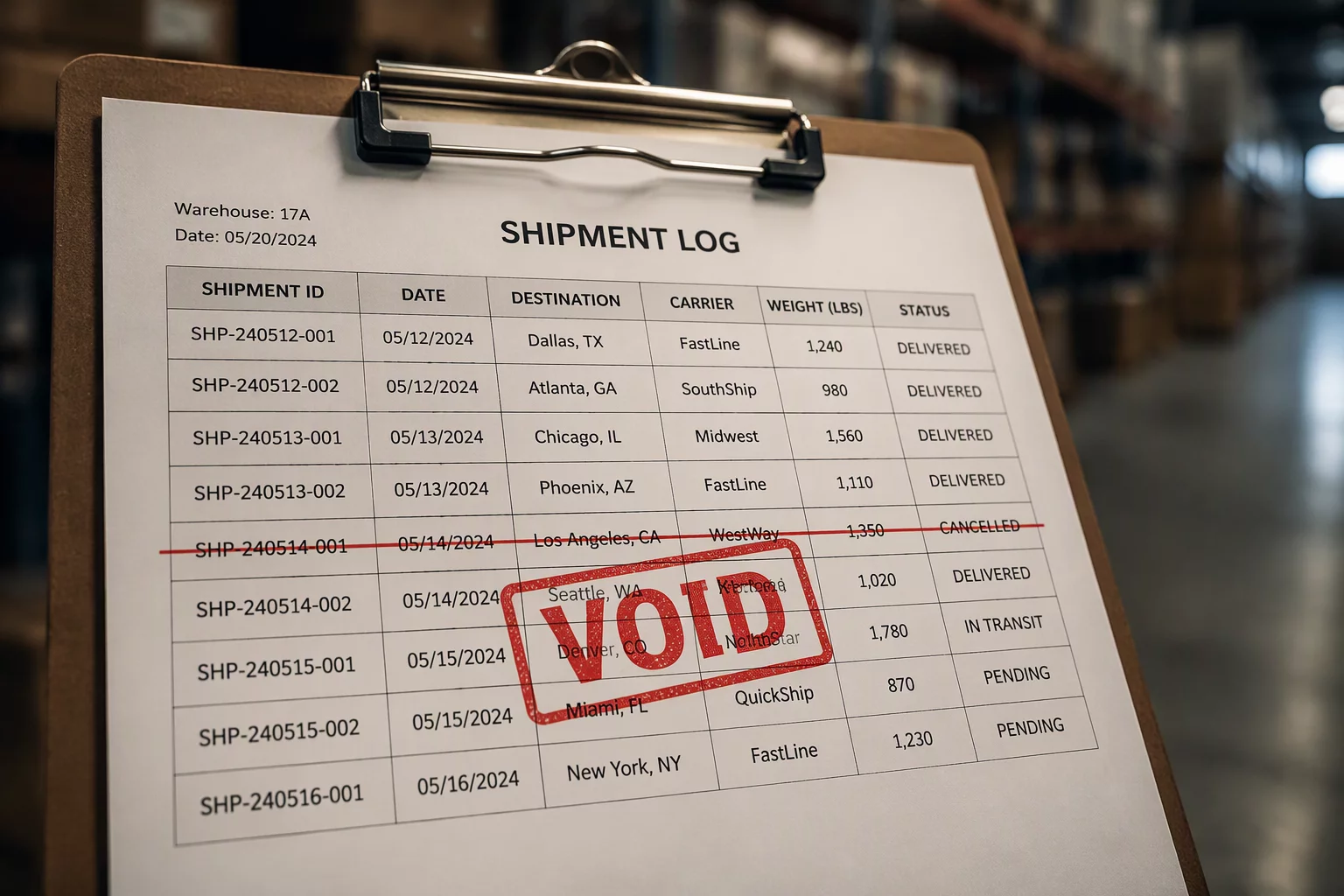 Void Cases
Key operational steps to reconcile close sheets when package records get canceled post-handoff without driver notification.
 End-of-Day
Standardized triage criteria for segregating stranded shipments, unlinked tracking numbers, and mismatched weights.
 Reconciliation
Auditing the handoff gap between shipping station completion and automated ERP inventory release triggers.